
Kabaddi — From the Soil to the Global Stage: The Complete Story of a Sport
कबड्डी क्या है? कबड्डी भारतीय उपमहाद्वीप से उत्पन्न एक संपर्क-आधारित टीम खेल है, जिसमें सात-सात खिलाड़ियों की दो टीमें होती हैं। एक रेडर विरोधी क्षेत्र में जाकर खिलाड़ियों को छूकर अपनी ज़मीन पर लौटता है, जबकि 'कबड्डी' का उच्चारण करते हुए सांस नियंत्रित रखनी होती है। खेल में टच पॉइंट, बोनस पॉइंट, टैकल, सुपर टैकल, डू-ऑर-डाई रेड और ऑल आउट जैसे नियम प्रचलित हैं। कबड्डी एशियाई खेलों का आधिकारिक खेल है और पेशेवर लीग ने इसे वैश्विक दर्शकों तक पहुँचाया है। महिला कबड्डी भी तेज़ी से विस्तार पा रही है, हालाँकि बुनियादी ढाँचा, वित्तीय सुरक्षा और प्रशिक्षण में असमानता अभी भी बड़ी चुनौतियाँ हैं।
Kabaddi belongs to that category of sport which, at first glance, seems to have almost nothing in it — no ball, no bat, no racket, no elaborate equipment. Just an open field, seven players on each side, a line, and a single word chanted again and again by one player as he charges into enemy territory. Yet it is precisely in this simplicity that the sport's depth lies. In one thirty-second raid, physical strength, breath control, collective cohesion, the courage of standing alone, and tactical intelligence are all tested at once. Kabaddi is a sport born from the soil of the Indian subcontinent, which today is part of the Asian Games, reaches crores of viewers on television as a professional league, and continues to push for a global identity.
Origins: the roots of an ancient game
Kabaddi is counted among the world's oldest sports. Its roots lie in the folk traditions of the Indian subcontinent, where for centuries physical contests of this kind have been played on the open fields of villages. A popular reference in folk memory is the chakravyuha of the Mahabharata, in which Abhimanyu enters the enemy formation alone and is surrounded on all sides. The theoretical structure of kabaddi mirrors this story: a lone raider, inside the opposition, and then the struggle to return safely. Historically the sport existed across the region under different names and different rules. In South India it was called hu-tu-tu, in eastern India ha-du-du, in Bengal hadudu, in the west kauddi, and in Punjab and much of northern India kabaddi. Names changed, the size of the field changed, rules adapted to local needs — but the core idea remained the same: hold your breath, touch the opponent, return to your own ground.
In the twentieth century the process of organising the sport began. In India, work was done to standardise rules at the national level, to systematise competitions, and to take the game to schools, colleges and state level. In this period a standardised rulebook emerged, the dimensions of the field were fixed, and the sport acquired an institutional framework. This foundation later became the basis for international expansion.
How the game is played: the essentials of the rules
The biggest feature of kabaddi is that its field and rules are straightforward, yet their possibilities are vast. The standard field is rectangular, with a midline running through the centre and areas for attack and defence on either side. Each team has seven players on the field and some in reserve. Certain important lines — the baulk line, the bonus line — define attacking and defensive strategy.
The focal point of the game is the raider. The raider must cross the midline into enemy territory, and while doing so must continuously chant 'kabaddi-kabaddi'. This word is not merely a formality — it is a means of controlling breath and measuring time. If the raider's breath breaks or he stops chanting, he is deemed out. A raid has a time limit, within which he must touch an opposing player and return to his own half. Touching earns a point; but if the opposing defenders catch and stop him, the point goes to the opposition and the raider is out.
The scoring system makes the game compelling. Normally, touching an opponent earns one point. Touching a defender beyond the bonus line and returning safely earns an additional bonus point. Defenders who catch and stop the raider earn points, and a successful collective defence can sometimes become a 'super tackle', which carries special value. When all players of the opposing team are out, an 'all out' occurs, points are awarded, and all opposing players return to the field. There is also the 'do-or-die raid' rule — after a series of empty raids, the raider has no option but to score, and failure means he is out. This rule adds both drama and pressure.
Strategy: the true mental side of the game
Kabaddi is often understood as a game of strength, but at the highest level it is more or less chess in which bodies are the pieces. The raider has fixed options: he can escape with quick feet, duck down and pull a defender by the ankle or thigh, or slip through the gaps between defenders. His success depends on how quickly he reads the opposition's structure — which corner is weak, which defender steps forward too early, where the space is.
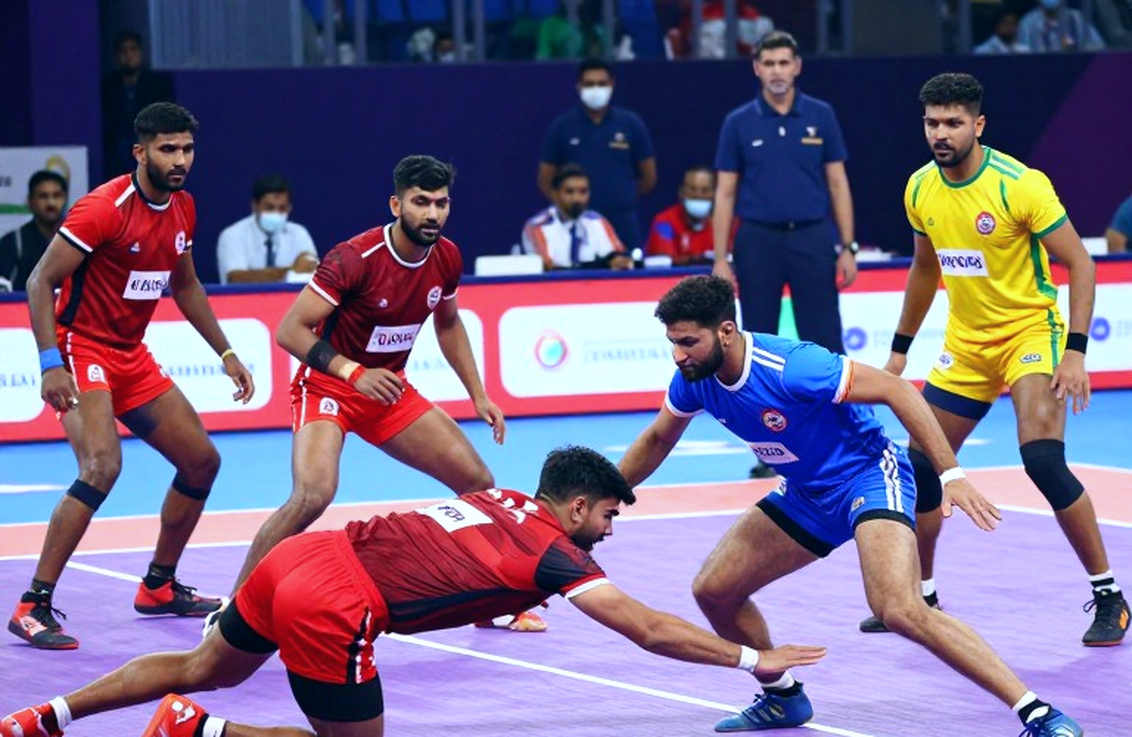
For the defenders the task is even more complex. They must work together. Corner defenders are the most important, because they limit the raider's routes in and out. Central defenders apply pressure on the raider. One wrong step, one delay, and the raider gets a chance to escape safely. Therefore collective understanding, communication and cooperation are the greatest strengths of a team. The 'chain tackle' technique, in which defenders link up like a chain to stop the raider, is counted among the most effective strategies of the modern game.
The raider also possesses the art of the 'dubki', or ducking low to slip past defenders. Top-level players create situations through body control, quick reaction and intuition in which opponents forget their plans. Another dimension is time management. A raider who senses he may be caught can deliberately linger near the midline to run down the clock; but the rules do not allow this indefinitely. This is where the subtlety of the game begins.
Organisation and the domestic structure in India
The responsibility for organising kabaddi in India rests mainly with national and state-level federations. These bodies conduct tournaments, register players, train coaches and referees, and work to take the sport to schools and colleges. National championships, junior and sub-junior competitions, and inter-university games are key parts of this framework. These competitions have played an important role in discovering talent and taking it to the national and international stage.
There is a system of national honours and awards for excellence in the sport, which provides encouragement to players. States have also introduced schemes to promote the game. However, the challenge is that resources are still unevenly distributed — some states have better grounds, coaches and training facilities, while others lack basic infrastructure. A talented player from a rural area often falls behind for want of resources, even though the sport's core base is strongest in rural India.
The professional league and the changing face of the game
The arrival of the professional league is regarded as a decisive turning point in the modern history of kabaddi. It transformed the sport from a traditional competition into a television product. Rules were adapted somewhat to make the game more attractive to viewers — faster pace, clear time limits, and dramatic concepts like the do-or-die raid and super tackle made it more engaging. Team participation in the league, player selection through auctions, the presence of foreign players and professional training structures took the sport to a new level.
The impact on players' livelihoods was clear. Earlier many talented players combined jobs with the sport; now they have the option of making the game itself a career. New professions such as coaching, physiotherapy, analysis and performance management have emerged. Alongside, commentary, team branding and spectator culture have changed the sport's identity. The league has helped take the game from villages to cities and from school grounds to large stadiums, although the process has not been entirely inclusive.
Kabaddi on the international stage
Internationally, kabaddi's biggest identity is linked to the Asian Games, where it holds official sport status. In addition, the Asian Kabaddi Championship and world-level competitions have shaped the sport's international form. India has been the strongest side in the game, but over time other countries — especially Iran, South Korea, Bangladesh, Pakistan and several East Asian nations — have improved their standards. This has made contests more competitive and expanded the sport into new markets.
India's performance at the Asian Games remained impressive for a long time, but in recent years improvements in other countries' training structures and technical development have narrowed the gap. This competition is good for the sport, as it reduces the dominance of a single side and increases the game's global appeal. At the same time, issues such as refereeing, uniformity of rules and player safety remain important in international competitions.
Women's kabaddi: a growing landscape
Women's kabaddi is now gaining recognition as a separate, independent stream of the sport. The introduction of the women's category at the Asian Games gave it a major platform, and women's leagues and competitions are now being held domestically as well. This has shown girls a path to take up the sport seriously. However, several challenges remain — lack of training facilities, awareness of safety and health, social pressure, and inequality in financial support. Nevertheless, the growing confidence of women players and their participation in the media is a sign of this change.
Physical demands and training
The physical demands of kabaddi are very specific. For the raider the greatest challenge is running continuously while holding the breath, changing direction quickly and escaping the opponent's grip. This requires lung capacity, foot speed, balance and flexibility. For the defender, strength, reaction time and collective coordination matter. Training includes sprints, agility drills, strength training, core stability and breath-control exercises. In the modern era, video analysis and data-based measurement of players' performance capacity is also gaining ground. Physiotherapy and recovery protocols are gradually becoming integral to the sport to prevent injuries.
The challenges facing the sport
There are several obstacles in the path of kabaddi's development. The first is basic infrastructure — proper grounds and training facilities are not available in many areas, and players often practise on traditional mud fields. The second is financial security. The professional league has benefited some players, but a large number remain outside competition and lack a stable source of income. The third is the standardisation of coaching and refereeing — a shortage of good coaches directly affects player development. In addition, injury management, the integrity of the sport, equal opportunities for women's sport and competition from other sports are also important issues.
Future prospects
There are several positive signals for kabaddi's future. A growing television audience, the sport's popularity on digital platforms and the expansion of the professional league are key factors. Popularising the game at school level, establishing training academies and organising international competitions can further extend its reach. In some circles there is also a demand to include it in the Olympic Games, although this is a long and complex process.
Conclusion
Kabaddi is a sport that has travelled from its folk form to an organised, professional and international form. It is not only part of India's cultural heritage but also a platform where discipline, courage and collectivity are recognised. The sport's greatest strength is its simplicity — it can be played without equipment and without heavy expense, from village soil to large stadiums. If attention is paid at the administrative level to basic infrastructure, training and financial security, and if women's sport is given equal opportunity, the game can broaden its identity further. A single word — 'kabaddi' — which generations of children have played, is today moving towards a new direction on the global stage.