
Kabaddi's New Era: From the Muddy Akhara to Data
कबड्डी पिछले एक दशक में शौकिया खेल से पेशेवर, रणनीति-केंद्रित खेल में बदला है। बदलाव के तीन मुख्य कारण हैं: पहला, 2014 में शुरू हुई पेशेवर लीग ने नीलामी, अनुबंध और टेलीविज़न दर्शकों के जरिए आर्थिक ढाँचा बनाया; दूसरा, मैट पर खेलने से गति और दिशा-परिवर्तन तेज हुआ, जिससे रेडिंग में ताकत की जगह तकनीक और छूकर निकलने की कला प्रमुख हुई; तीसरा, वीडियो और डेटा विश्लेषण से प्रतिद्वंद्वी की आदतों पर आधारित तैयारी आम हुई। रणनीति की दृष्टि से डू-ऑर-डाई रेड, सुपर टैकल और चेन टैकल निर्णायक हैं, क्योंकि ये अंकों का गणित एक ही क्षण में पलट सकते हैं। चुनौतियाँ स्पष्ट हैं: मैचों की निकटता से रिकवरी का समय कम होना, टखने-घुटने-कंधे की चोटें, और शीर्ष रेडर तथा सामान्य बचावकर्ता के बीच भुगतान की खाई। भविष्य की दिशा प्रशिक्षण और खेल-चिकित्सा विज्ञान में निवेश, जमीनी स्तर पर प्रतिभा-चयन का विस्तार, और पारंपरिक मिट्टी-आधारित संस्कृति को पेशेवर ढाँचे के साथ जोड़ने पर निर्भर करती है।
There are two ways to watch kabaddi. In the first, the game is played in an empty field at the edge of a village: no referee, no camera, just one boy running with his breath held and seven or eight hands closing in behind him. In the second, the same game is played indoors, under three cameras, in front of a coach with a clipboard and an analyst with a screen. The distance between those two pictures is the real story of kabaddi over the past decade. The rules have barely changed; the structure around them has been rebuilt — amateur to professional, physical to strategic, local to broadcast. When the country's first professional kabaddi league launched in 2026, many treated it as a television experiment. Ten years on, it is clear the experiment was not only about broadcast but about the internal logic of the game. Players once picked purely for strength and stamina are now expected to read an opponent's habits, price risk, and account for every step.
The core rule is simple, and that simplicity is its strength. A raider crosses into the opponent's half, keeps chanting kabaddi continuously, touches a defender and returns to his own half. A touch scores a point and sends the defender out. If the raider is caught, he leaves. If the whole team is out, the opposition earns bonus points. But the pressure inside those clean sentences is the real test: a thirty-second clock, the obligation to keep chanting on a single breath, and the requirement to cross the line on the way back. One moment of hesitation and the entire raid is wasted. That is why decision speed matters as much as physical capacity. The raider has thirty seconds, but in practice he must decide within one or two seconds of entering the opponent's half whom to touch, which angle to take, and where the return path is still open.
The surface has shaped strategy more than anything else. On clay, players compete barefoot; grip is strong, slipping is rare, and falling is survivable. But speed is slower, because the ground holds the player at every turn. On the mat the game is different — faster surface, quicker changes of direction, and therefore more room for the raider to take risk. In exchange, ankle and knee injuries rise, because the body decelerates abruptly and the load lands on the joint. Many coaches argue clay teaches patience and the mat teaches speed. The professional league prioritised the mat because it is cleaner for cameras, quicker for viewers, and more controllable for broadcast. Yet clay survives in traditional competitions, and that difference shapes players' careers.
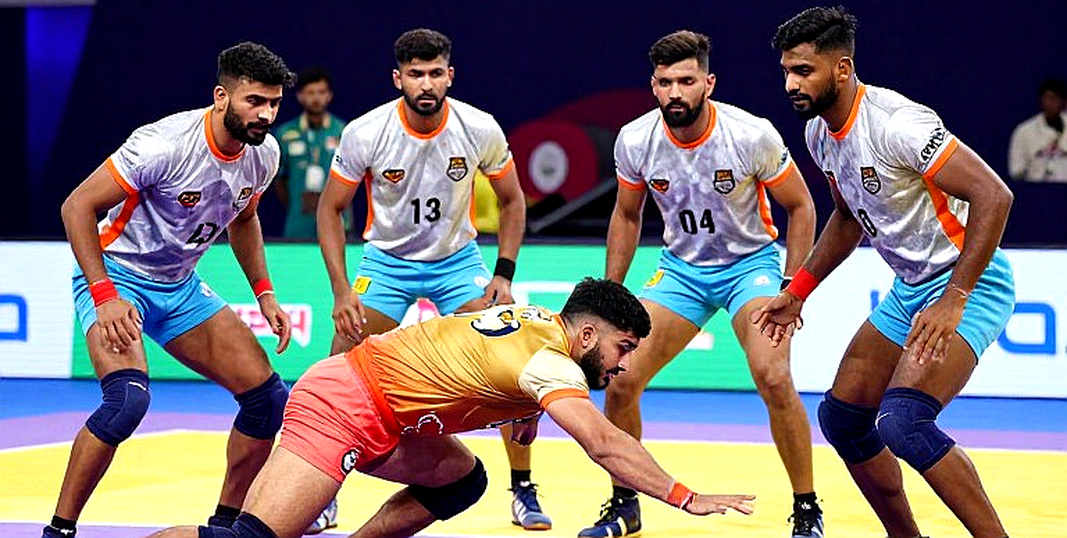
Raiding has changed face. The powerful raider once meant a big body, a long reach, a straight strike. That space has now been taken by the art of touching and escaping. Hand touch, toe touch, twisting past a defender's shoulder — each technique carries a different risk. The hand touch is considered safest because the body stays distant, though the danger of being grabbed remains. The toe touch is prized because it forces the defender off balance, but a slip can trap the raider himself. Then there is the do-or-die raid: after three consecutive empty raids, the fourth must produce a point or the raider goes out. That rule is the game's greatest dramatic device and, today, its most strategic one. Coaches now plan the third raid differently, because it is no longer just a raid but a decision that sets the team's position.
Defence has become collective. The corners — left and right — are counted among the most experienced players, because they must read the raider's direction and commit alone. The covers in the middle close the return path. In modern defence the chain tackle is standard: one player holds the ankle, a second controls the thigh, a third blocks from above. It all depends on coordination, and one late arrival breaks the chain. The special case is the super tackle, when a team reduced in numbers still brings the raider down and earns double points. That is the moment the arithmetic of the match flips, and it is why coaches treat defence as an investment rather than mere prevention.
Video analysis has entered kabaddi as well. Coaching staff now collect an opposing raider's tendencies: which direction he takes on the first raid, what he chooses under pressure, what his success rate is on the left corner. Tackle timing and body lean are analysed the same way. Data does not perform magic, but it replaces guesswork with preparation. Decisions once left to experience now sit on top of clips and numbers. The consequence is that a player's value is judged not only on physical capacity but on how coachable he is — whether he can put the plan onto the mat.
The load on the body deserves attention. Kabaddi involves repeated sprints, sudden stops, changes of direction and falls. It rewards anaerobic explosion more than aerobic endurance, along with core stability, ankle balance and shoulder-neck strength. The most common injuries are to the ankle, knee and shoulder. The mat increases stress on knee ligaments; clay adds abrasion injuries to the skin. A crowded professional calendar leaves little recovery time, and that is where the biggest gap opens: teams with physios, trainers and recovery protocols keep players standing until the end of the season. Teams without them fade in the final phase despite having talent.
The map of the sport has changed too. Outside India, Iran has long been a strong opponent, built on disciplined defence and restraint in the raid. South Korea, Bangladesh, Kenya and a few European countries show structured efforts. Kabaddi's place in the Asian Games gives it a stable international framework, offering a different incentive from the commercial league. The two structures taste different — the league fast, sponsored and entertainment-driven; the international game built on patience, process and comparison between nations. Living both lives is not easy for a player, because the demands and the preparation differ.
The economic picture is mixed. The professional league created a platform that did not exist before — auctions, contracts, sponsorships and television audiences. For players from rural backgrounds it also became a route to social mobility. But the pay gap is wide: the difference between a top raider and an ordinary defender is large, and careers are short. Protection after injury depends on the team and the contract. On the other hand, visibility has increased participation at the grassroots — more school and club competitions, which will determine the quality of talent in the long run.
The question ahead is how kabaddi will hold its two identities together. On one side is the demand for entertainment and broadcast, which pushes the sport to be faster, more controlled and more viewer-friendly. On the other is the root of the game — the akhara, the clay, the endurance and the informal culture that made it a mass sport. There is only one way to keep both: investment in coaching and sports medicine, so the burden of rising speed does not fall on the player's body, and so talent identification does not shrink to urban academies. Technique will keep changing and numbers will keep growing, but the essence of kabaddi will remain — one breath, one step, and the art of understanding your own move before the other man's eyes do.
संबंधित खिलाड़ी
अनुशंसित
India vs England, Match 4: At the Commonwealth Kabaddi Championship, the Squad Audition Is the Real Story, Not the Scoreline2026-10-24
Commonwealth Kabaddi: India Beat England 46–26, but Demand the Receipt for Both 'Asian Games 2026 Gold' and 'Commonwealth'2026-10-26
Pakistan's Commonwealth Kabaddi Exit: A Circle-Style Inheritance, a Standard-Style Sentence2026-10-23
The Ledger Behind 55-38: Kabaddi's Real Bookkeeping Never Shows Up in the Scoreline2026-10-30
Kabaddi: From the Muddy Akhada to a Global League2026-11-02
अनुशंसित
Ahmedabad's First Commonwealth Kabaddi Championship: 13 Nations, 62 Matches and India's Six Games in Seven Days2026-10-23
Kabaddi: From the Muddy Akhada to a Global League2026-11-02
Commonwealth Kabaddi Championship 2026: A Fourth Place Built on Nothing, and a Day-1 Table That Predicts Almost Nothing2026-10-24
Commonwealth Kabaddi Championship 2026: 13 Nations, Nine Days, and an Empty Broadcast Column in Ahmedabad2026-10-30
Kabaddi: A Sport That Needs Only Breath, but Still Needs More Muscle for the Market2026-10-31
अनुशंसित
First Commonwealth Kabaddi in Ahmedabad: 13 Nations, 62 Matches, and the Arithmetic of a Thinner Women's Draw2026-10-26
Commonwealth Kabaddi Championship 2026, Day 1: The Ahmedabad Points Table Is Ranking Teams Nobody Has Watched2026-10-24
The Notebook Says Otherwise: Why Kabaddi's Numbers Need an Audit2026-10-24
The Column Nobody Was Meant to Read: PKL's Real Market Runs on the Wage Line2026-10-27