
Ahmedabad’s Commonwealth Kabaddi Test: Two Captains, 62 Matches and a Calendar Trap
**कोर उत्तर:** कॉमनवेल्थ कबड्डी चैंपियनशिप 23 से 31 अक्टूबर 2026 तक अहमदाबाद के वीर सावरकर स्पोर्ट्स कॉम्प्लेक्स में होगी, जिसमें 13 देशों की 23 टीमें 62 मैच खेलेंगी। **मुख्य तथ्य:** - पुरुष वर्ग में 13 टीमें और 39 मैच; महिला वर्ग में 10 टीमें और 23 मैच हैं। - भारतीय पुरुष टीम 23 अक्टूबर 2026 को इंग्लैंड से और महिला टीम मलेशिया से खेलेगी। - पुरुष कप्तान सुरजीत सिंह और महिला कप्तान निधि शर्मा हैं; उप-कप्तान क्रमशः नवीन कुमार और रितु हैं। - सेमीफाइनल 30 अक्टूबर 2026 को और दोनों फाइनल 31 अक्टूबर 2026 को होंगे। - आयोजन अमेच्योर कबड्डी फेडरेशन ऑफ इंडिया कर रहा है, जिसे इंटरनेशनल कबड्डी फेडरेशन की मंजूरी है। **स्रोत:** आयोजक विज्ञप्ति और प्रकाशित रिपोर्ट, 22 अक्टूबर 2026। **संबंधित प्रश्न-उत्तर:** प्रश्न: भारत के पुरुष ग्रुप A में कौन-कौन सी टीमें हैं? उत्तर: भारत, नाइजीरिया, मलेशिया, युगांडा, इंग्लैंड, तंजानिया और श्रीलंका। प्रश्न: भारतीय महिला टीम का पहला मुकाबला कब और किससे है? उत्तर: 23 अक्टूबर 2026 को शाम 6:45 बजे मलेशिया से। प्रश्न: क्या कबड्डी 2030 राष्ट्रमंडल खेलों में शामिल है? उत्तर: अभी पुष्टि नहीं है; अहमदाबाद इस चैंपियनशिप को 2030 की तैयारी के दृश्यता-टेस्ट के रूप में उपयोग कर रहा है।
At 6:45 PM on Friday at the Veer Savarkar Sports Complex in Ahmedabad, India’s women’s team opens against Malaysia. At 8:30 PM, the men’s team faces England. Earlier, at 11:00 AM, Kenya meets Singapore in a men’s Group B match. The opening-day sheet looks like a schedule. For me, it is the first data point in a 62-match tournament.
I have rewatched the 2026 World Cup final and the 2026 Jakarta semifinal enough times to know what empty stadiums reveal. With the noise stripped out, cant discipline, do-or-die decisions and defender communication become visible. Ahmedabad will have a crowd. I will treat it as a variable, not as proof of a result.
This is the inaugural Commonwealth Kabaddi Championship. The nine-day event runs from October 23 to 31, 2026, with 23 teams from 13 nations playing 62 matches: 39 men’s and 23 women’s. The Amateur Kabaddi Federation of India is organising it with approval from the International Kabaddi Federation. Ahmedabad is preparing to host the 2030 Commonwealth Games, so this championship is a visibility test for that bid. Kabaddi’s inclusion in the 2030 programme is not confirmed.
The men’s competition has 13 teams in two groups. India is in Group A with Nigeria, Malaysia, Uganda, England, Tanzania and Sri Lanka. Group B has Bangladesh, Kenya, Canada, Australia, Scotland and Singapore. The women’s competition has 10 teams in two groups of five. India is in Group A with Singapore, Nigeria, Uganda and Malaysia. Group B has Bangladesh, Kenya, England, Scotland and Sri Lanka.
Surjeet Singh captains the Indian men’s team, with Naveen Kumar as vice-captain. The 14-member squad includes Sachin Tanwar, Pankaj Mohite, Bharat Hooda, Shubham Shinde and Parvesh Bhainswal. Nidhi Sharma captains the women’s team, with Ritu as vice-captain. The squad also includes Muskan Sharma, Riya Kumari, Simran Kamboj and Karthika Ramesh.
India’s men play England, Uganda, Malaysia, Nigeria, Tanzania and Sri Lanka. The women play Malaysia, Singapore, Uganda and Nigeria. The top two teams from each group reach the semifinals on October 30. Both finals are on October 31.
The arithmetic of 39 and 23 is the real story. In the men’s event, a seven-team Group A produces 21 matches and a six-team Group B produces 15. Two semifinals and a final take the total to 39. In the women’s event, two five-team groups produce 20 matches; two semifinals and a final make 23. There are no quarterfinals. This is a full round-robin, where every team gets one look at every other team.
The format creates a calendar trap. India’s men play six group matches on October 23, 24, 25, 26, 27 and 29. October 28 is a rest day, followed by Sri Lanka on October 29 and a semifinal on October 30. The women play four straight days from October 23 to 26, then wait until the October 30 semifinal. The men’s group is stretched; the women’s group is compressed.
The Patna three-peat looks like dominance until you count the third repeat. I count the mechanics before the medals. Here, the question is not how many recognizable names India has. The question is how a raider’s do-or-die conversion survives four matches in four days. The women get a long break after October 26, but rhythm can leave during a break. The men get a recovery day on October 28, but October 29 and 30 back-to-back will raise the tackle-point load.
Captaincy matters in the same way. Surjeet Singh is captain and Naveen Kumar is vice-captain. Nidhi Sharma is captain and Ritu is vice-captain. Captaincy is not a badge; it is a timeout decision and a do-or-die call. In a compressed group, the captain decides who rests and which defender holds which side.
India’s men open against England. England is easy to underestimate, but the first match is never the easiest. A second-session opener, a home crowd and Uganda the next day mean India must set its raiding rhythm immediately. Malaysia serves the same purpose for the women.
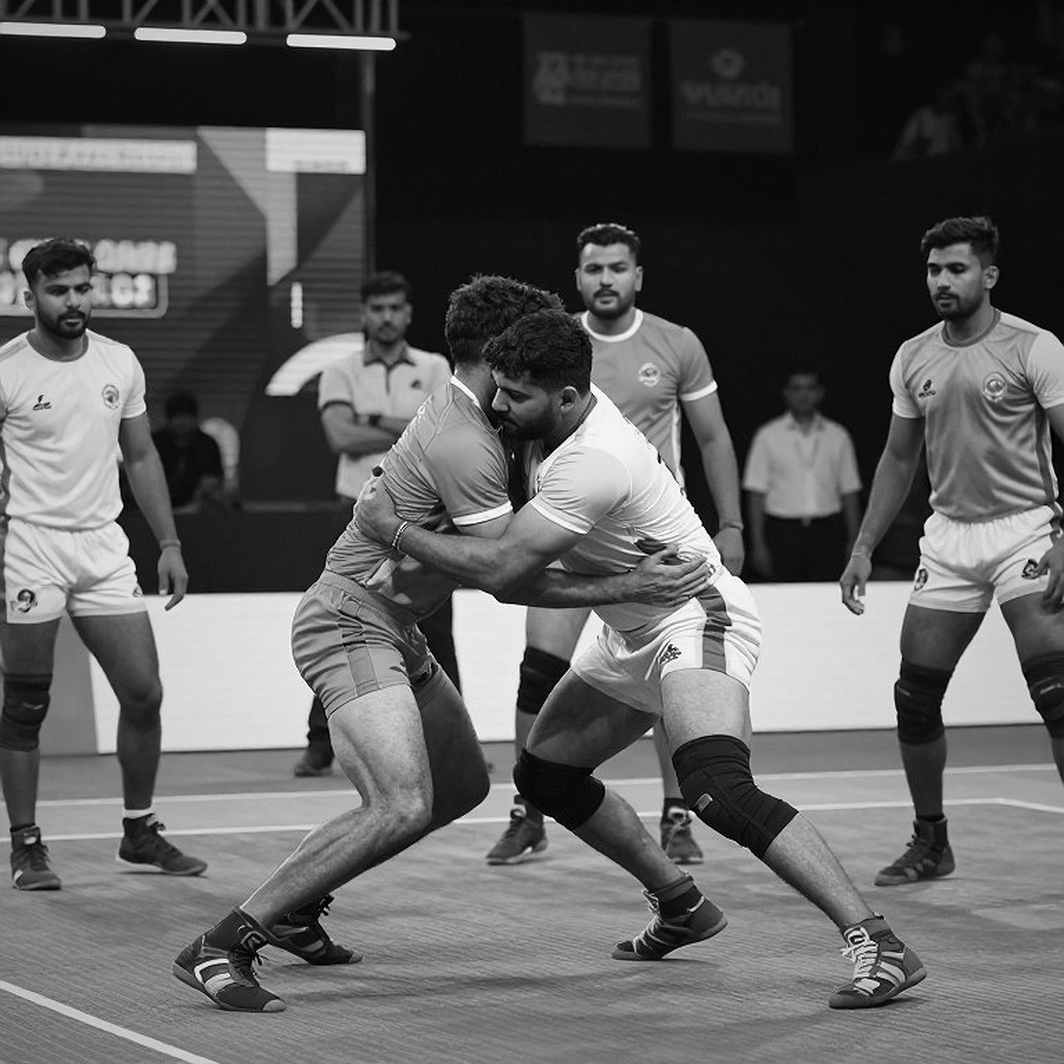
I called Iran co-favorites in 2026, and the tape has argued with me since. Iran is not here. Reading this tournament as a direct Asian Games forecast would be a mistake. The Commonwealth field is a different sample. Treat it as a separate control group, not as proof for the Asian Games.
After three reps, the Raid Room asks what the broadcast does not: what was the raid type, what was the support angle, and where did the defensive chain break? In Ahmedabad I will keep those three columns. Without them, 62 matches become a scorecard with noise.
My strongest objection is to treating this tournament as a guaranteed Indian title. India is the clear favorite in both events. Home conditions, squad depth and format help. The real test is how India builds habits against weaker opponents. If the women’s do-or-die conversion drops after four straight days, that is a selection and rotation story, not only a fitness story.
The strongest counterargument is that India’s bench is deep enough to neutralize the calendar. If Naveen Kumar, Sachin Tanwar and Pankaj Mohite share the raiding load, the six-match pressure can ease. Nidhi Sharma and Ritu can rotate the women’s unit. That argument can hold. But a 14-player squad still puts seven on the mat. Rotation freedom is limited.
My testable prediction: India will finish in the top two of both Group A pools, but the path to both finals will be shaped by the calendar, not by reputation. I will watch the women’s match against Nigeria on October 26 and the men’s match against Sri Lanka on October 29. If do-or-die conversion falls below 50 percent in those games, rotation must change before the semifinals.
Ahmedabad’s crowd will make this tournament feel large. The question is whether the crowd becomes data or noise. After the evening of October 31, I will have 62 matches of tape. I will not ask who won the trophy. I will ask which team kept its cant discipline after four matches in four days.