
Commonwealth Kabaddi Championship: 62 Matches in Ahmedabad, and the Real Gap Is in the Schedule, Not the Scoreline
**मूल उत्तर:** पहली कॉमनवेल्थ कबड्डी चैंपियनशिप 23 से 31 अक्टूबर 2026 तक अहमदाबाद के वीर सवारकर स्पोर्ट्स कॉम्प्लेक्स में होगी। 13 देशों की 23 टीमें 62 मैच खेलेंगी — 39 पुरुष और 23 महिला। भारत का पहला मुक़ाबला 23 अक्टूबर को महिला वर्ग में मलेशिया और पुरुष वर्ग में इंग्लैंड से है। **मुख्य तथ्य:** - आयोजन 9 दिन, 13 देश, 23 टीमें और कुल 62 मैच — जिनमें 39 पुरुष व 23 महिला फ़िक्स्चर हैं। - पुरुष कप्तान सूरजीत सिंह, उपकप्तान नवीन कुमार; महिला कप्तान निधि शर्मा, उपकप्तान रितु। - पुरुष ग्रुप A में 7 और ग्रुप B में 6 टीमें; महिला वर्ग में 5-5 टीमों के दो ग्रुप। - पुरुष चैंपियन को 9 दिन में 8 मैच, महिला चैंपियन को 6 मैच खेलने हैं। - सेमीफ़ाइनल 30 अक्टूबर, दोनों फ़ाइनल 31 अक्टूबर 2026 को निर्धारित हैं। **स्रोत:** अमेच्योर कबड्डी फ़ेडरेशन ऑफ़ इंडिया द्वारा जारी शेड्यूल एवं स्क्वाड विज्ञप्ति, 22 अक्टूबर 2026। **संबंधित प्रश्न-उत्तर:** प्रश्न: भारत का पहला पुरुष मैच किससे और कब है? उत्तर: 23 अक्टूबर 2026 को रात 8:30 बजे इंग्लैंड के खिलाफ़। प्रश्न: भारतीय महिला टीम का ग्रुप चरण किन टीमों से है? उत्तर: सिंगापुर, नाइजीरिया, युगांडा और मलेशिया — ग्रुप A में कुल पाँच टीमें। प्रश्न: क्या कबड्डी 2030 कॉमनवेल्थ गेम्स का हिस्सा बन चुकी है? उत्तर: नहीं — खेल कार्यक्रम कॉमनवेल्थ गेम्स फ़ेडरेशन तय करता है और अभी कोई आधिकारिक पुष्टि नहीं है।
Veer Savarkar Sports Complex, Ahmedabad. Friday, 11:00 AM. Kenya against Singapore, the opening match of men's Group B. No Indian player will be on the mat at that hour. The women's team plays Malaysia at 6:45 PM; the men's team plays England at 8:30 PM.
That gap — between eleven in the morning and a quarter to seven — describes the whole tournament. Twenty-three teams, thirteen nations, nine days, sixty-two matches. Thirty-nine men's fixtures, twenty-three women's.
I opened a fresh page on 22 October, the day the schedule and squad release landed. The arithmetic checks out. Which is where the questions start.
The part every report will lead with: thirteen men's teams in two groups. Group A carries India, Nigeria, Malaysia, Uganda, England, Tanzania and Sri Lanka; Group B carries Bangladesh, Kenya, Canada, Australia, Scotland and Singapore. Ten women's teams in two groups of five — India with Singapore, Nigeria, Uganda and Malaysia in Group A, and Bangladesh, Kenya, England, Scotland and Sri Lanka in Group B. Surjeet Singh captains the men, Naveen Kumar is his vice-captain. Nidhi Sharma leads the women, with Ritu as deputy.
India's men face England on 23 October, Uganda on the 24th, Malaysia on the 25th, Nigeria on the 26th, Tanzania on the 27th and Sri Lanka on the 29th. The women meet Malaysia, then Singapore on the 24th, Uganda on the 25th and Nigeria on the 26th. Semifinals on 30 October; both finals on 31 October. The Amateur Kabaddi Federation of India runs it with International Kabaddi Federation approval, and every release mentions that Ahmedabad is preparing to host the 2030 Commonwealth Games.
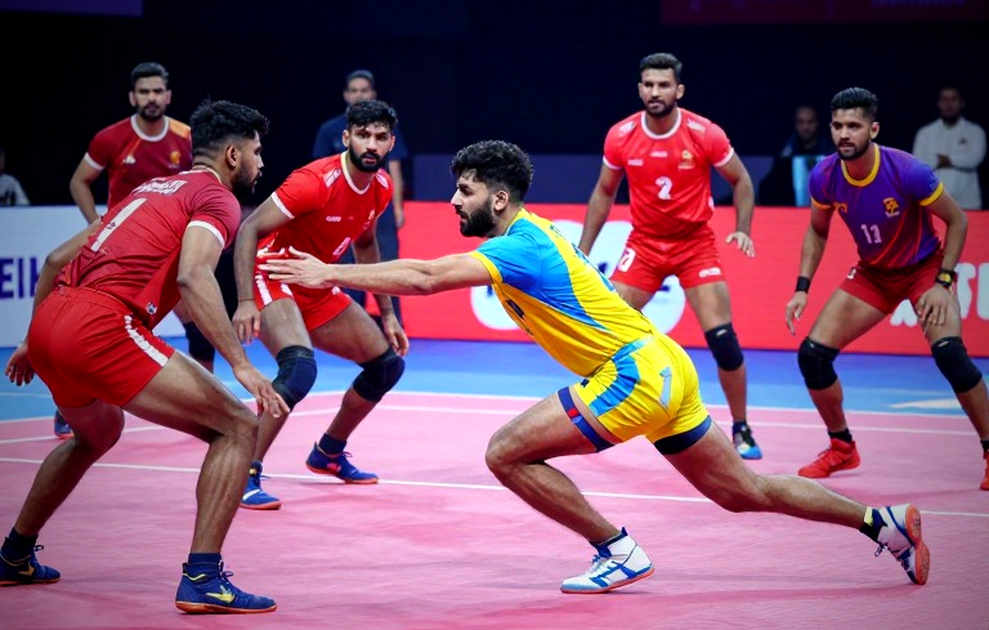
Now the ledger I keep. Seven teams in men's Group A, six in Group B. A seven-team round robin gives each side six group games; a six-team group gives five. So the men's champion needs eight matches in nine days — six group, a semi, a final. The women's champion needs six — four group, a semi, a final. Thirty-six of the 39 men's matches are group stage; twenty of the 23 women's matches are. In a tournament whose stated purpose is to give the women's game a stage, the women's champion plays twenty-five per cent fewer matches than the men's champion — not through any design, simply because the field is ten teams instead of thirteen. The arithmetic could have been fixed. It wasn't.
A second count nobody published. The men's release names six of the fourteen-man squad — Surjeet Singh, Naveen Kumar, Sachin Tanwar, Pankaj Mohite, Bharat Hooda, Shubham Shinde and Parvesh Bhainswal, seven names in all. The rest do not appear. Six women's names appear — Nidhi Sharma, Ritu, Muskan Sharma, Riya Kumari, Simran Kamboj, Karthika Ramesh. The eight or nine players who will actually step onto that mat in Ahmedabad are not on any document available today. I kept the notebook through fourteen issues because last place still keeps score; here the score cannot be kept because the names come first, and the names are missing.
Then the thing least said. These 23 teams come from three different kabaddi traditions, gathered under one Commonwealth roof.
The first is circle style — Malaysia and Singapore. Everything visible on this circuit suggests both nations' kabaddi is built through Tamil-diaspora clubs and schools, where circle style came first and standard style arrived later. India's women therefore open against opposition with a low-centre defensive grip and a raid rhythm our domestic circuit only shows every few years. It reads as a soft start. My notebook has it as an unknown one.
The second tradition is African — Kenya, Uganda, Nigeria, Tanzania. Remember Kenya's name, because it is not arriving in Ahmedabad for the first time. The Kabaddi World Cup was played in this city in October 2026, and Kenya was in that field. Ten years later the same country opens another multi-nation event in the same city. That is continuity, and continuity is the least-recorded thing in international kabaddi coverage.
The third is diaspora-club — England, Scotland, Canada, Australia. England's men meet India on day one. As this circuit reads, British kabaddi is built out of British-Asian community clubs in the Midlands: technically a branch of Indian kabaddi playing under a different flag. For India this is not a contest. It is a rhythm exercise.
Rhythm is the actual challenge. The squad Surjeet Singh leads — Naveen Kumar, Sachin Tanwar, Pankaj Mohite and Bharat Hooda in the raiding line, Shubham Shinde and Parvesh Bhainswal at the back — sits a league above the rest of this field on paper. Nobody is beating India between 23 and 27 October. The question is whether those four matches prepare the side for 29 October, when Sri Lanka arrive. Sri Lanka are the one team in this group with a settled standard-style international calendar and a defence accustomed to reading Indian raiders. One match in this group matters, and it is on the sixth day, not the fifth.
The women's side is a longer story. Four Asian Games golds — 2026, 2026, 2026, 2026 — and still no franchise league. Under Nidhi Sharma and Ritu, this team plays four group matches, three of them straight on paper and one, Malaysia, technically awkward. Jakarta 2026 is physics, not morality: Iran's wrestling-built defence, selection on reputation. This year the real test does not begin until the semifinal, because Group B carries both Bangladesh and Sri Lanka.
Here is where I get uncomfortable. Every report contains the sentence: Ahmedabad is preparing for the 2030 Commonwealth Games, so this championship is a big step for the sport. The first clause is true. The second is an inference written as fact. The Commonwealth Games Federation sets the sports programme, not the host city, and kabaddi has never been a core sport on it. A nine-day championship strengthens a bid. It does not guarantee a medal event. Treating 2030 as settled is the same mistake kabaddi coverage has made for twenty years: converting an assumption into an achievement.
The second discomfort: this tournament is not built for India. India will almost certainly win it, which makes India's role here host and sponsor rather than competitor. It is built for the twelve nations that get no international fixtures otherwise. Kenya, Uganda, Tanzania, Nigeria, Scotland — five or six matches in nine days is a season's progress. Which is the contradiction: the teams that need the most matches sit in a six-team group and get five, while the team that needs them least gets six. This is a host's draw, not a development draw.
One last thing, important only because nobody has mentioned it: who keeps the data for 62 matches? Will every match sheet — score, raid-point differential, tackle count — be published, or will only the final survive 31 October? The editor cut Jakarta to 500 words and I learned to listen for what survived. Of these 62 matches, if nothing survives the edit, next year's analysis will have no baseline — and it is easy to write that India is dominant without one. It is not easy to prove it.
Watch the evening of 29 October. If India find their raiding rhythm inside four minutes, 31 October is a formality and the question becomes what this tournament gave Indian kabaddi that it did not already have. If they don't, the question becomes who the nine days and eight matches were for. Neither answer is on the scoreboard. Both are in a schedule released on 22 October.