
Konstas's 151* Is a Selection Signal; Aaron Hardie's Shoulder Is the Real Story
**मुख्य उत्तर:** सैम कोन्स्टास ने शेफील्ड शील्ड में वेस्टर्न ऑस्ट्रेलिया के खिलाफ 167 गेंदों पर 151* रन बनाए, जिससे न्यू साउथ वेल्स ने 364 का लक्ष्य रखा और WA का स्कोर 30/3 हो गया। इसी मैच में एरोन हार्डी की कंधे की चोट ने WA की उपलब्धता संकट पैदा की। **मुख्य तथ्य:** - कोन्स्टास ने दोनों पारियों में 71 और 151* रन बनाए; यह उनका पांचवां प्रथम श्रेणी शतक था, 136 गेंदों पर पूरा। - NSW ने 440 और 262/5d बनाया, WA ने 339 बनाए; स्टंप्स से एक घंटा पहले घोषणा हुई। - हार्डी 52 रन बनाकर कंधे की चोट से बाहर हुए; मेडिकल सब्स्टिट्यूशन पर 12 दिन का अनिवार्य स्टैंड-डाउन लागू हुआ। - झाय रिचर्डसन ने ओली डेविस को दो बार बाउंसर पर आउट किया; कोरी रोकिचियोली ने 3/90 लिए। - WA के तीन कप्तान एक ही मैच में बदले — हार्डी, कार्टराइट, फिर पेरिस और शॉ। **स्रोत:** शेफील्ड शील्ड मैच रिपोर्ट (NSW बनाम WA, वाका, तीसरा दिन) | Cross-checked: cricsultan.com **संबंधित प्रश्न-उत्तर:** प्रश्न: क्या कोन्स्टास टेस्ट टीम के लिए तैयार हैं? उत्तर: उनकी दो-पारी की निरंतरता मजबूत संकेत है, पर उपलब्ध आंकड़े केवल एक घरेलू मैच के हैं और विदेशी या तेज़ गेंदबाज़ी-गुणवत्ता विभाजन प्रस्तुत नहीं है। प्रश्न: हार्डी कितने मुकाबले चूकेंगे? उत्तर: मेडिकल सब्स्टिट्यूशन नियम के तहत कम से कम 12 दिन का स्टैंड-डाउन अनिवार्य है, जो स्कैन नतीजे आने पर बढ़ सकता है। प्रश्न: क्या WA अभी भी यह मैच जीत सकता है? उत्तर: शांत वाका सतह पर चौथा दिन सबसे अच्छा बल्लेबाज़ी दिन होना चाहिए, इसलिए सुबह की पहली घंटी पार करना WA के लिए निर्णायक होगा।
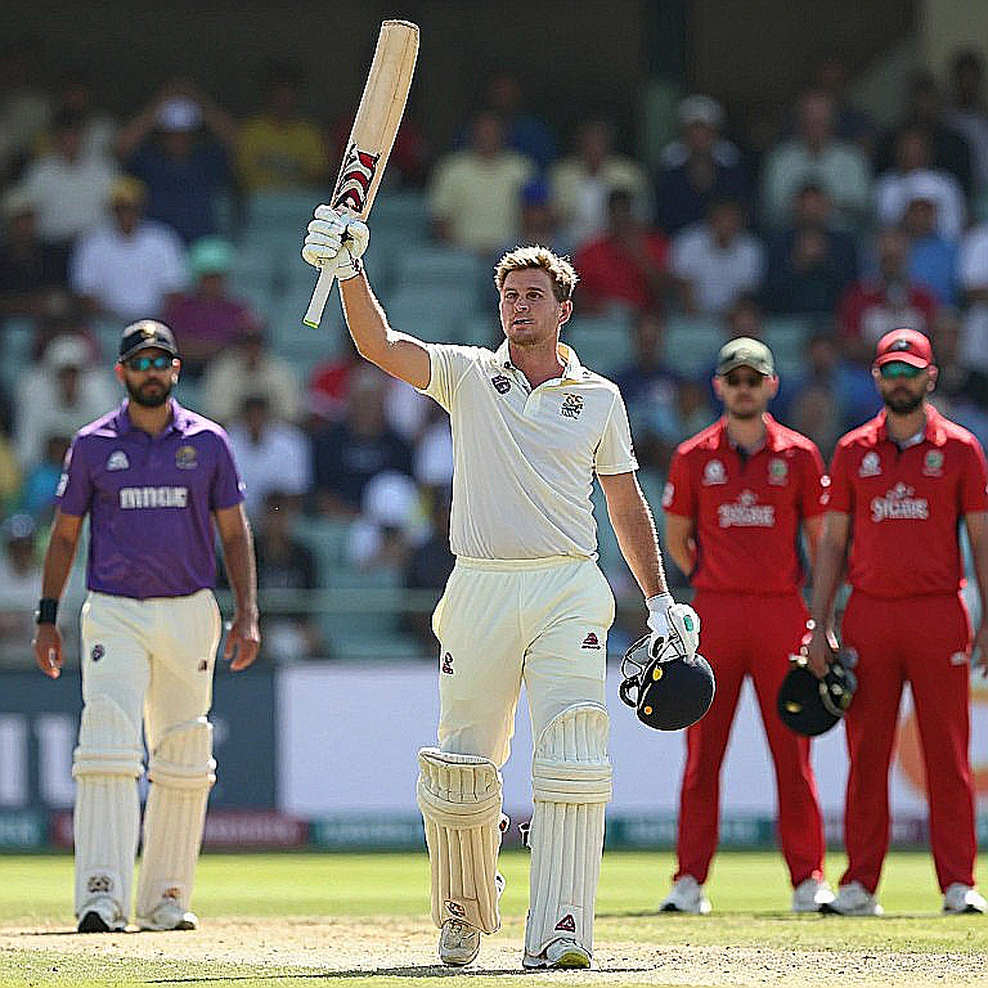
In the final hour of the third day at the WACA, Sam Konstas played one straight hit, the ball crossed the rope, and Tony Dodemaide — the national selector sitting in the terraces — broke into a grin that reached his ears. That moment will not appear on the scorecard. The scorecard will show 151 not out, 167 balls, four sixes.
A strike rate of roughly 90. In first-class cricket an opener's normal band is 50 to 60. Ninety is a statement, and mistaking a statement for a performance is the oldest habit in this sport.
I built the spreadsheet before I knew it was a resume. Since then there has been one rule — sample size first, claim second. That rule applies here too, because in this match one innings has knocked on the Test team's door and one shoulder has shaken an entire state's plan.
The match state is simple. New South Wales made 440, Western Australia 339, and then NSW declared at 262 for 5, just over an hour before stumps. WA need 364, with 334 still to get, seven wickets in hand, and the score reading 30 for 3. Three wickets in five deliveries.
This is the Sheffield Shield — Australia's premier domestic first-class competition, four days, red ball, and the country's primary Test-talent supply line. Every number here belongs to the first-class domain and must not be read across to ODI or T20 metrics. A strike rate of 90 means something entirely different here than 140 does in a T20.
The declaration timing is the real context for that innings. Pushing a batter into the hardest window of the day before the fourth morning is the oldest and most reliable leverage play in the Test format. The WACA surface was described as relatively docile, yet Ben Dwarshuis took 2 for 5 and Jack Edwards 1 for 0 on that same benign deck. Whether that was surface, seam, or dusk is not settled by the figures — but the timing is.
Having watched these domestic fixtures for years, one thing is clear: the Shield's product is not entertainment, it is Test cricketers. Which is precisely why Australia's batting trouble in South Africa lends this 151 not out the status of an answer. There is no statistical relationship between the two events. It is an editorial juxtaposition, and it should be labelled as one.
Here is the part that is real. Konstas made 71 in the first innings and 151 not out in the second. Two-innings consistency carries more weight than any single headline score, because it steps outside the single-innings-flash trap. This was his fifth first-class century, reached off 136 balls. His career-best first-class score is 152 — the declaration denied him the chance to pass it. Marginal, but worth noting.
The innings was reportedly built on mostly orthodox strokes at good pace, with four sixes and a straight hit as the standout shot. That is a technical soundness signal. Young batters usually buy runs with high-risk strokeplay and get caught doing it; 151 off 167 balls with only four sixes suggests boundaries without recklessness.
NSW's batting depth was validated in the same match. Kurtis Patterson made 122 in the first innings, Ollie Davies 52 off 58 balls on the first morning, Hicks finished 35 not out. Konstas was not the lone source — that is the mark of a top-tier domestic batting unit.
Davies is the counter-image in this story. Against Tasmania in his previous Shield match he made 253 off 225 balls. Here he was dismissed twice to Jhye Richardson bouncers. One plan, the same outcome twice. That is a genuine technical flag, and Test-level pace attacks target exactly that spot. The interesting detail is that Konstas answered the same short ball by swatting it over deep square leg — the counter had a counter.
Richardson himself is buried by the result. He took 5 for 19 against Queensland in his previous match and removed Davies twice with the bouncer here. He is WA's genuine strike weapon, even if the scorecard sends his name into Konstas's shadow. Corey Rocchiccioli, at the other end, took 3 for 90, including Patterson, Edwards and Shaw. Ninety runs for three wickets is expensive on a docile surface, but on day four the same spinner could be the decisive threat.
Now the part the report gave the least room to — Aaron Hardie. Shoulder injury while batting on day two, clutching it repeatedly, 52 runs and out. Uncapped Corey Wasley came in through a medical substitution, and the rule attached a mandatory 12-day stand-down. That guarantees at least two fixtures missed, and the scan could extend it.
Hardie's record puts that injury in a different light. The knee is already being managed — he began the season as a specialist batter and missed the Australia A tour of India. Now the shoulder. Fifteen ODIs and 18 T20Is are proof of capability, but capability and availability are different assets. The 80 not out at No. 5 against Queensland is real batting form — delivered by a player whose bowling is being rationed. Batting value high, bowling value suppressed: that is the most expensive shape of all-rounder risk.
WA's problem is structural, not tactical. Three captains in one match — Hardie, then Hilton Cartwright (finger injury in the field), then Joel Paris and Shaw. Three hands on the tiller in a single innings is a declaration of instability before a wicket falls. And the fact that Cartwright is being listed as available to bat on day four confirms the team is running on injuries, not on form.
This is where I put a brake on the whole narrative. Konstas's innings is genuine — two innings, a fifth century, orthodox strokeplay. But it is one match, on home soil. The report carries no away or overseas splits, no breakdown against quality pace, no career average. The actual Test-readiness test is precisely what is missing.
The 90 strike rate may itself be an artifact. An innings played in front of a watching selector invites faster scoring. The figure showing aggressive intent may equally be showing performance intent. Separating the two requires the true tempo of his next five or six innings.
Likewise, reading Dwarshuis's 2 for 5 and Edwards's 1 for 0 as bowling dominance is the classic small-sample error. Those figures describe the timing of wickets, not sustained control. Three wickets in five deliveries is enough to swing a match and not enough to judge a bowler.
And here is what score-watchers miss: on a docile surface, day four should be the best batting day. The chasing side has seven wickets. If WA survive the first hour, this match is far less settled than a 334-run gap implies. The pressure is psychological, not pitch-based.
Filing Hardie's injury under a line about the task getting harder is the biggest mispricing in the piece. This is a multi-format all-rounder's long-term durability problem, not an incident. The knee was already managed; the shoulder has now joined it. For an all-rounder who bowls, a shoulder injury is far more expensive than for a specialist batter, because it touches the bowling action and the throw directly.
One line on selection politics. Konstas is not just a batter right now; he is a market — the next star. Broadcast, endorsement and fantasy pressure arrives fast around a name like that, and under that pressure a player's actual technical gaps get hidden. The name market is fast; the model is slow. I will stay with the model.
Tomorrow decides this match. The first hour will tell whether it is a chase or the first chapter of a defeat. And the most important information to follow will not be in the scorecard but in the medical bulletin — Hardie's scan. A significant finding there extends the 12-day floor and rewrites both WA's Shield and One-Day Cup campaigns.
For Konstas the next signal is specific: where does his next big score come from — a docile WACA surface, or quality pace on an overseas tour. The first is a selection data point. The second will be a capability data point. Only the first exists today, which is why I will wait one more innings before calling 151 not out a Test answer.
संबंधित खिलाड़ी
अनुशंसित
All Eight Columns Came Back 'Insufficient Information' — and That Was the Cleanest Thing in the Report2026-10-23
The Complete-Looking Empty Report: In Cricket, the Strongest Evidence of Injury Is What Was Never Logged2026-10-24
The Ledger Came Back Blank: In Cricket, What Never Gets Filed Is the Real Story2026-10-25
Nortje's Groin and the Decider's Clock: The Arithmetic the Scorecard Never Records2026-10-25
Kotak's Praise and the Scorebook's Silence: India's 226 Chase at Christchurch2026-10-24
अनुशंसित
Shadab Khan's Hundred and the Last-Wicket Maths No Model Has Learned2026-10-26
Konstas's 151* Is a Selection Signal; Aaron Hardie's Shoulder Is the Real Story2026-10-23
NZC Exits the MLC Franchise Partnership: The Cheapest Deal to Unwind Is the One With No Money In It2026-10-23
Sri Lanka's Historic Chase: The Echo of 93 Fours and the Tale of 552 Boundary Runs2026-10-24
Kishan's Adductor Strain and the Real Test of India's Bench Depth2026-10-23
अनुशंसित
Before Newlands: South Africa's 110/6 Is Both Its Best Evidence and Its Biggest Warning2026-10-23
NZC Exits the MLC Franchise Partnership: The Cheapest Deal to Unwind Is the One With No Money In It2026-10-23
Wisden's Unanswered Quiz Question: The Captain-Keeper-Opener Rarity and the Depth of Indian Opening Batting2026-10-24
Sri Lanka's Historic Chase: The Echo of 93 Fours and the Tale of 552 Boundary Runs2026-10-24
The Question Behind the Quiz: Why Indian Cricket's Captain-Keeper-Opener Overlap Is So Rare2026-10-23