
KabaddiKabaddi: From the Mud Akhara to League Lights — A Complete Primer on India's Traditional Sport
Kabaddi: From the Mud Akhara to League Lights — A Complete Primer on India's Traditional Sport
कबड्डी क्या है: यह एक संपर्क आधारित सामूहिक खेल है जिसमें हर टीम में सात खिलाड़ी मैदान पर होते हैं; रेडर को विपक्षी हिस्से में जाकर कम से कम एक डिफेंडर को छूकर लौटना होता है, और रेड के दौरान लगातार 'कबड्डी' कहते हुए सांस बनाए रखनी होती है। स्कोरिंग: एक टच पर एक अंक, निर्धारित क्षेत्र में टच पर बोनस अंक, और सभी डिफेंडरों के आउट होने पर दो अतिरिक्त अंक (लोना/ऑल आउट); आउट खिलाड़ी रिवाइवल से वापस आ सकते हैं। मैदान: पुरुषों का मानक आकार लगभग 13×10 मीटर, बीच से दो हिस्सों में विभाजित; प्रोफेशनल लीग में रेड की समय-सीमा 30 सेकंड। इतिहास: नाम तमिल 'काई' (हाथ) और 'पिडी' (पकड़ना) से जुड़ा माना जाता है; देश में इसे हुतुतु, हाड़ूडू, कौड़ी, सडुगुडु, चेडुगुडु जैसे नामों से खेला जाता रहा है। अंतरराष्ट्रीय पहचान: 1990 बीजिंग एशियाई खेलों से आधिकारिक पदक स्पर्धा; भारत पारंपरिक रूप से सबसे मज़बूत टीम, ईरान प्रमुख प्रतिस्पर्धी। व्यावसायिक मोड़: प्रोफेशनल कबड्डी लीग की शुरुआत 2014 में, जिसने प्रसारण, अनुबंध और प्रशिक्षण को बदला। सीमाएँ: खेल का प्रसार मुख्यतः दक्षिण एशिया तक सीमित, जमीनी ढाँचे और चिकित्सा सुविधाओं की कमी। (नोट: यह कैप्सूल सामान्य परिचय पर आधारित है; किसी विशेष मैच, स्कोर, तारीख़ या खिलाड़ी के प्रदर्शन का दावा नहीं करता।)
(This is a general/background original piece, not a report on a specific news event.)
Kabaddi is one of the few sports where the greatest weapon is not a piece of equipment but a single held breath. No ball, no bat, no racket — just two teams of seven and a rule that demands body and mind to work at once. A raider must cross into the opponent's half, touch someone, and return while holding his breath; one careless moment and he is caught. That simplicity is kabaddi's greatest strength: it needs no expensive gear, only a patch of ground.
The name itself describes the sport. "Kabaddi" is widely traced to the Tamil words kai (hand) and pidi (to catch). Across India it has carried many names — hututu in Maharashtra, ha-du-du in Bengal, kauddi in Punjab, sadugudu in Tamil Nadu, chedugudu in Andhra and Karnataka. The names changed; the soul of the rule did not. One player enters enemy territory alone and must come back alive.
Folklore links kabaddi to the Mahabharata, comparing Abhimanyu's lone entry into the chakravyuh and his encirclement to a raider surrounded by defenders. That is a cultural metaphor, not historical evidence, but it shows how deeply the game sits in the region's storytelling. The credit for organising kabaddi into a modern, codified sport belongs to twentieth-century India, when the game was measured, timed and given a competitive structure.
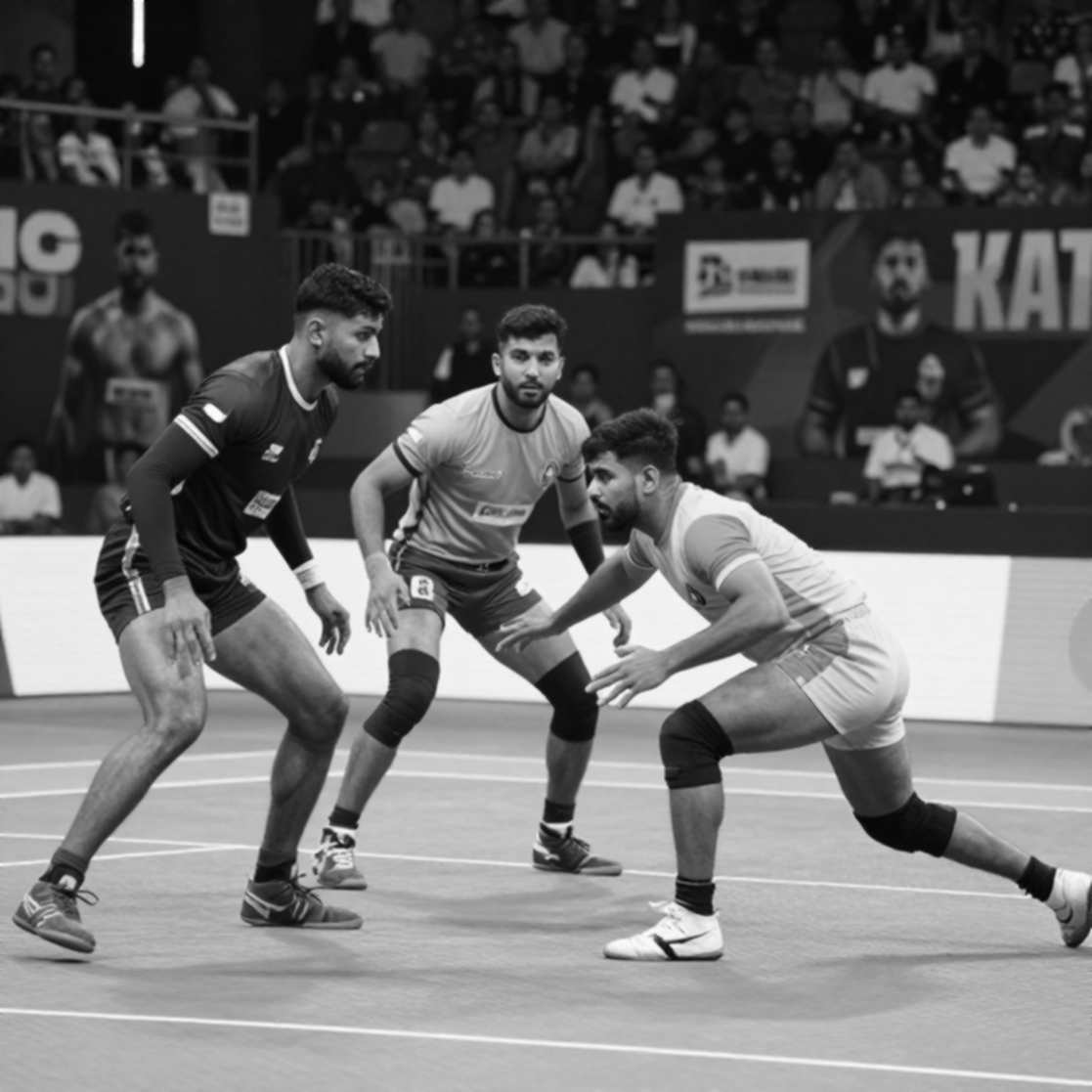
The basic layout matters. A standard men's court is roughly 13 by 10 metres, divided into two halves. Each team fields seven players, with substitutes outside. During a raid, the raider must enter the opponent's half within a set time, touch at least one defender and return to his own half. In the professional league that limit is 30 seconds, and the raider must chant "kabaddi, kabaddi" continuously — the rule that turns the sport into a test of breath control.
Several things are decided at once during a raid. Once the raider crosses the line he is live; if any part of him touches out of bounds or the lobby, he is out. Defenders try to stop him by grabbing, encircling or pulling his leg — the struggle. Their real test is the tackling zone in the middle, which is both the sport's greatest strength and its greatest risk: one wrong grip and the raider scores.
The scoring is simple, its consequences tactical. Touching one defender and returning earns a point, and the touched player goes out. Bonus points are available when a raider touches a defender in a designated area. If a raider dismisses every defender, the team earns two extra points for a "lona" or all-out — the moment that most often flips a match. Dismissed players leave the mat and can return through a revival when the opposition loses a player or points are scored. That is why no lead is safe until the final minute.
The tactical layers run as deep as the physical pressure. A raider must decide when and where to go, which defender to target and when to retreat. Some rely on speed and sudden changes, some on strength and grip, others on feints that confuse defenders. In defence, corner players are crucial, trapping raiders near the boundary; cover players hold the middle. A well-drilled defence often wins matches on its own, because a fraction of a second's hesitation is enough.
Physically, kabaddi is extraordinarily demanding. Sprinting, stopping, turning, ducking, jumping and falling all happen within seconds. The compulsion to play while holding the breath tests lung capacity and mental discipline alike. Injury risk is high, with knees, ankles and shoulders most exposed in collisions and tackles. Modern teams therefore treat physiotherapy, taping and recovery protocols as seriously as strategy.
The biggest shift came with the professional kabaddi league, launched in 2026. It made the sport television-friendly — better courts, mats, broadcast graphics and a platform that gave players both recognition and financial security. Players who once competed before empty village grounds now perform before thousands and under substantial contracts. The change made training more scientific, popularised video analysis and turned the sport into a viable career for a new generation.
Internationally, kabaddi's strongest identity is tied to the Asian Games, where it became an official medal event at Beijing 2026. Asian championships and world-level events have also been held periodically. India has traditionally been the sport's strongest nation, while teams such as Iran have made competition considerably tougher over the past two decades. The game has spread beyond South Asia, though reach and resources there remain limited.
In India, kabaddi's real strength lies in its villages and schools. A sport that began on mud courts is still most alive where expensive sports are out of reach. Many well-known players come from families where no other path was visible. That social backdrop is why kabaddi is seen not merely as a game but as a route to opportunity. National championships and inter-university competitions have long been the backbone of its supply chain.
Women's kabaddi has built a distinct identity in recent years. Court dimensions and team structures differ slightly from the men's game, but the core challenge is the same. Growing participation in national and international competitions, and exposure through league platforms, has given visibility to players who were previously outside the media's view. The change is slow, but the direction is clear.
A large part of kabaddi's popularity is that it is eminently watchable. There is no long wait; a new contest begins every 30 seconds. Spectators need little effort to follow the rules — who was caught, who went out, how many points were scored is understood in a moment. That accessibility made it popular on television and now on mobile screens. It is also one of the few sports where physical contact and strategy are so tightly interwoven that every raid becomes a small story.
The challenges are considerable. The sport's spread has remained largely confined to South Asia; establishing roots in Europe and the Americas will take time. At the grassroots level, shortages of grounds, coaches and medical facilities persist. Many talented players leave the game prematurely under financial pressure. The league changed the picture, but its benefits have not reached everyone equally. If the sport is to build a stronger global identity over the next decade, investment must extend beyond the television product to the grassroots structure.
Through all of this, kabaddi's defining feature remains what it was centuries ago — it runs on the human body, breath and judgement, not on expensive equipment. When a raider enters enemy territory holding his breath, only his courage and his plan are on the court. That simplicity sets it apart in a crowded field of sports, and it is why a game from the mud akhara now stands under league lights.
(Note: this text covers the sport's general background, rules, structure and development. It makes no claim about any specific match, tournament, date, score or player performance.)
संबंधित खिलाड़ी
अनुशंसित
Kabaddi: From the Village Akhada to the Global Stage — The Changing Face of a Sport2026-11-02
Commonwealth Kabaddi Championship 2026: A Fourth Place Built on Nothing, and a Day-1 Table That Predicts Almost Nothing2026-10-24
Kabaddi: From the Mud Akhara to League Lights — A Complete Primer on India's Traditional Sport2026-11-02
Commonwealth Kabaddi: India Beat England 46–26, but Demand the Receipt for Both 'Asian Games 2026 Gold' and 'Commonwealth'2026-10-26
The Retention Ledger: What 1,842 Coded Clips Say About a Defender's Real Price2026-11-02
अनुशंसित
Commonwealth Kabaddi Championship 2026, Day 1: The Ahmedabad Points Table Is Ranking Teams Nobody Has Watched2026-10-24
The Notebook Says Otherwise: Why Kabaddi's Numbers Need an Audit2026-10-24
Commonwealth Kabaddi Championship 2026: 13 Nations, Nine Days in Ahmedabad — and a Broadcaster Nobody Has Named2026-10-23
India vs England, Commonwealth Kabaddi Championship 2026: This Match Tests New Faces, Not India's Ceiling2026-10-24
Commonwealth Kabaddi: India Beat England 46–26, but Demand the Receipt for Both 'Asian Games 2026 Gold' and 'Commonwealth'2026-10-26
अनुशंसित
Surjeet Singh captain, Naveen Kumar deputy: the Ahmedabad announcement that arrived without a squad2026-10-24
India vs England, Match 4: At the Commonwealth Kabaddi Championship, the Squad Audition Is the Real Story, Not the Scoreline2026-10-24
Commonwealth Kabaddi Championship 2026, Day 1: The Ahmedabad Points Table Is Ranking Teams Nobody Has Watched2026-10-24
Commonwealth Kabaddi Championship 2026: 13 Nations, Nine Days, and an Empty Broadcast Column in Ahmedabad2026-10-30
India vs England, Match 4, Commonwealth Kabaddi Championship 2026: Ahmedabad Will Give You a Big Score, Not a Big Answer2026-10-23