
Kabaddi Champions League: 10-Team Expansion and a Rs 5 Crore Auction Purse, But the Real Warning Lies Buried in the PKL Broadcast Crisis
कबड्डी चैंपियंस लीग ने टीमों की संख्या 8 से बढ़ाकर 10 की है और प्रति फ्रैंचाइजी नीलामी थैली 5 करोड़ रुपये (लगभग 6 लाख अमेरिकी डॉलर) तय की है। नीलामी में सबसे महंगे खिलाड़ी आयन लोचब 17.4 लाख रुपये में बिके, जबकि 'भारत के एशियाई खेलों के कप्तान' बताए गए सुनील मलिक 10 लाख रुपये में बिके — इन उपाधियों की स्वतंत्र पुष्टि नहीं हुई है। ट्रायल में करीब 6,400 खिलाड़ियों ने पंजीकरण कराया और 300 से अधिक नीलामी पूल में पहुंचे। लीग की सभी 10 फ्रैंचाइजी हरियाणा के शहरों से हैं, यानी यह क्षेत्रीय अर्ध-पेशेवर लीग है। सबसे महत्वपूर्ण संदर्भ यह है कि प्रो कबड्डी लीग का 13वां सीजन कथित तौर पर जून-जुलाई 2027 तक खिसक गया है क्योंकि नया प्रसारण अधिकार समझौता नहीं हुआ। लीग ने प्रसारण, प्रायोजन, दर्शक संख्या, राजस्व या AKFI/IKF मान्यता पर कोई जानकारी नहीं दी है।
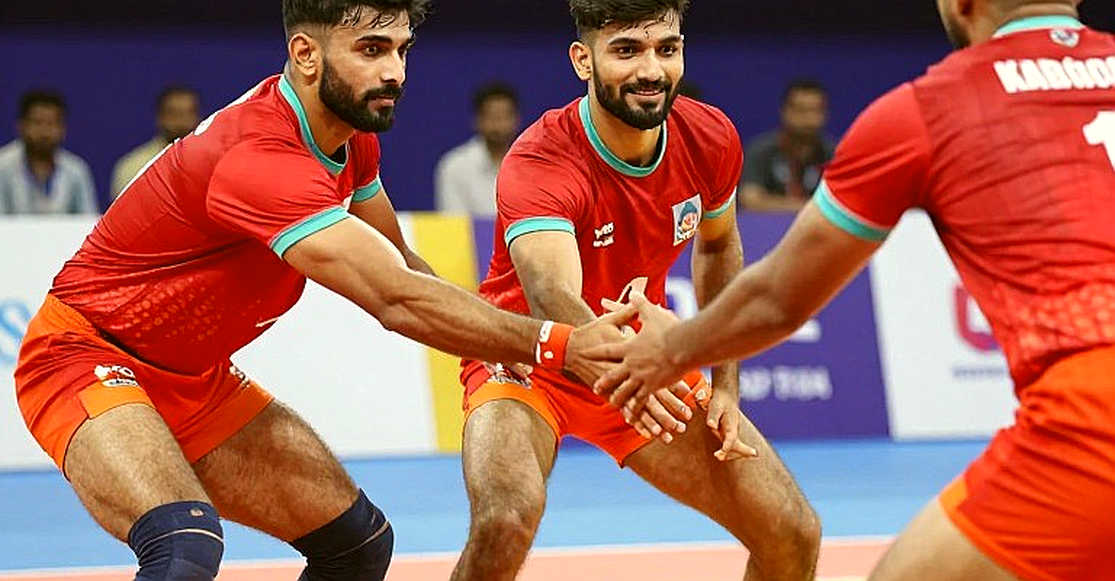
The Kabaddi Champions League, a Haryana-based competition, has announced two headline moves ahead of its next season: expansion from 8 to 10 franchises, and an auction purse of Rs 5 crore per franchise, framed as giving teams 'greater scope to assemble their squads.' The league also released its player-auction results. The highest-priced player was Ayan Lochab at Rs 17.4 lakh, while Sunil Malik — described in the report as 'India's Asian Games captain' — went for just Rs 10 lakh.
On the surface this is a positive growth story. But the fourth paragraph of the same report contains a far more consequential detail for the wider Indian kabaddi ecosystem: the Pro Kabaddi League's 13th season has reportedly been pushed to June-July 2027, with the absence of a broadcast partner cited as the cause. At the very moment a regional league is showcasing 'momentum,' the sport's commercial anchor is unstable.
This report is based on limited public information. Several figures — auction values, player credentials, the PKL calendar — have not been independently verified. All factual claims should be read at, at best, medium confidence.
Expansion: 8 to 10 teams, all in one state
The league has added two franchises to reach ten. The existing city list is revealing: Bhiwani, Rohtak, Karnal, Gurugram, Sonipat, Panipat, Faridabad, Hisar, Jhajjar and Kurukshetra — all in Haryana. Despite a national-sounding name borrowed from UEFA's Champions League, this is a regional, Haryana-centric competition. That is not inherently wrong: Haryana is India's traditional wrestling and kabaddi heartland, where rural akhada (mud-pit) culture has long converted into national and international athletes. But the gap between the name and the footprint should be stated plainly. There is no reported presence in Maharashtra, Punjab or South India.
Going from 8 to 10 teams is genuine expansion but small in scale. The critical unknown is season length. If the calendar is unchanged and two teams are added, either per-team fixtures shrink or the season stretches — both affect competitive quality. The league has not disclosed the format, fixture count or season calendar.
The Rs 5 crore purse: a big number with limited meaning
Rs 5 crore per franchise sounds imposing until it is placed in context. At prevailing rates that is roughly US$600,000 — a fraction of what PKL franchises have historically spent at auction. This is a developmental or semi-professional budget tier, not a claim to PKL-level competition.
More seriously, the report does not clarify whether the Rs 5 crore is per team or league-wide. The phrase 'greater scope to assemble their squads' points to the per-franchise reading, but the absence of an explicit statement is a material ambiguity. If Rs 5 crore were a league-wide budget, each of ten teams would have roughly Rs 50 lakh — implausibly low even for this level.
A simple arithmetic check: Rs 5 crore spread across a squad of 15 to 20 players implies an average salary of Rs 25-33 lakh. Yet the top auction price was only Rs 17.4 lakh. Either squads are unusually large, the purse is not being fully spent, or the budget figure is largely declarative. In none of those cases can auction prices be treated as evidence of league strength.
The player market: prices visible, quality not
Ayan Lochab topped the auction at Rs 17.4 lakh. Sunil Malik, labelled 'India's Asian Games captain,' went for Rs 10 lakh. If Malik genuinely captained India at the Asian Games, Rs 10 lakh is remarkably low; PKL raiders of international standard have commanded over Rs 1 crore. Either the 'Asian Games captain' label refers to a past edition or a different rule variant (Circle Style), or the description is inaccurate. Either way, this internal inconsistency is worth flagging: the market does not appear to be pricing international pedigree.
The larger gap is the complete absence of performance data. Five players are named, but there are no raid points, tackle points, success rates or match counts. Player quality cannot be assessed; only relative market prices are observable.
The trial pipeline: 6,400 registrations, a 300-player auction pool
The league reports roughly 6,400 trial registrations (a separate figure near 7,000 also appears), with more than 300 players eventually placed in the auction pool. This is the most concrete data point in the entire story. It demonstrates a deep reservoir of aspiration in Haryana's villages and small towns. But it is routinely misread as a popularity signal. It measures supply — rural youth chasing scarce sporting opportunity — not demand. And it implies that more than 6,000 trialists received no contract at all.
Against this figure, the report offers no attendance, ticketing, television rating or social-media data. The league's story is being built on the supply side (players, teams, trials), not the demand side (fans, revenue). That is the textbook early-stage expansion pattern in Indian non-cricket leagues.
The PKL crisis: the story missing from the headline
The most important information here is buried in paragraph four: the Pro Kabaddi League's 13th season may be deferred to June-July 2027 because the league has no broadcaster and no concrete sign of a new media-rights deal. Treating this as a scheduling adjustment would be a mistake. Kabaddi's professional rise since 2026 has rested entirely on broadcast — short format, fast matches, TV ratings, star-led marketing. If the flagship league has no media partner, three things come under pressure: player salaries, sponsorship, and the career pathway for athletes emerging from rural India. A delay of roughly a year is a commercial warning signal, not a calendar tweak.
Against that backdrop, the Champions League's expansion looks like an attempt to fill a vacuum. With PKL dormant, players need somewhere to play and organisers need attention. That is strategically understandable. But presenting it as evidence of league momentum is misleading. It is opportunism — favourable, but temporary. If PKL resolves its media rights and returns in mid-2027, this expansion may prove a one-season artifact.
The Haryana cultural context: from village to contract
Haryana illustrates kabaddi's social economy better than anywhere else. Athletes raised on akhada mud have long achieved social mobility through government jobs and sports quotas. The Champions League's 'village to league' narrative connects to that tradition and is authentic in spirit. But authenticity and impact are different things. With a top price of Rs 17.4 lakh, it is fair to ask whether the league meaningfully changes livelihoods or merely provides a seasonal opportunity. In Haryana's sports economy, a government job remains the real social safety net; a league contract is a supplement, not a substitute.
One more point on branding: 'Champions League' borrows prestige from European football. There appears to be no legal conflict in India, but the name can lead casual readers to overestimate the league's status and competitive level. It is a branding choice, not a measure of quality.
Commercial structure: expansion claims, no revenue evidence
The largest analytical gap is the complete absence of commercial fundamentals: no broadcast deal, no sponsorship, no ticketing revenue, no attendance, no franchise fee. Without any of that, '8 to 10 teams' and 'a Rs 5 crore purse' rest on no revenue-side evidence. It is reasonable to infer, consistent with early-stage Indian leagues, that the budget is being funded by franchise owners or a promoter rather than earned through league revenue. If so, the expansion is not self-sustaining — it is sponsored spending contingent on a backer's enthusiasm.
The silence on broadcast is itself a signal: at present the league's media-rights value is likely negligible. Without media visibility there is no player fame; without fame there is no sponsorship; without sponsorship salaries do not rise. That cycle does not appear to have started.
Governance: the biggest unanswered question
The report is entirely silent on who runs the league. Is it sanctioned by the Amateur Kabaddi Federation of India? Is it a privately promoted competition? Does it relate at all to the International Kabaddi Federation's architecture? For any professional league this is not a bureaucratic detail — it directly affects player eligibility. If an unsanctioned league expands rapidly, it becomes a classic shadow-federation risk: it can fragment the player market and complicate national-team selection. That risk is amplified for players being given international-sounding credentials.
Similarly absent: standard player contracts, anti-doping arrangements, referee standardisation, and even the rule variant in use (Standard or Circle Style). A league expanding quickly without clarifying its institutional identity is drifting toward governance conflict.
Risk register
Commercial risk is highest: no broadcast, no sponsorship, no revenue disclosure. Ecosystem risk follows: the entire sport leans on PKL, which is itself in crisis. Professionalisation risk: salaries far below PKL will not retain top talent. Governance risk: sanctioning and eligibility unclear. Reputational risk: a regional league with a national-sounding name. Sporting risk: no performance data, so competitive quality cannot be assessed. Overall risk is high — driven less by this small regional enterprise than by the context in which it is being reported.
Conclusion: the headline and the real story diverge
The Kabaddi Champions League is a Haryana-focused, semi-professional development league. Its genuine asset is its grassroots pipeline — over 6,400 trial registrations. Its genuine weaknesses are the absence of commercial transparency and the opacity of its institutional identity. And its real news is not the expansion but the crisis running alongside it: the PKL's broadcaster-less future.
It is more accurate to describe this as a temporary restructuring of Indian kabaddi's middle tier than as the sport's expansion. That restructuring creates opportunity — rural players get a platform — and risk: a platform without broadcast, sanctioning or revenue may prove hollow quickly.
Signals to monitor
One: a new PKL media-rights deal. If it is signed and Season 13 returns on schedule, ecosystem uncertainty eases and the Champions League reverts to feeder status. Two: the league's sanctioning status with AKFI or IKF. Three: any broadcast or digital rights agreement, which would be the first hard validation of the expansion claim. Four: official confirmation of Sunil Malik's 'Asian Games captain' credential. Five: any attendance or revenue figure from a completed season — the first real test of sustainability.
Glossary
Kabaddi: a 7v7 contact sport in which a raider enters the opponent's half chanting 'kabaddi' continuously and scores by touching defenders and returning safely. PKL: Pro Kabaddi League, India's flagship professional kabaddi competition, founded 2026. Auction purse: the total per-franchise budget available for bidding at the player auction — not prize money. Crore/lakh: Indian numbering; 1 crore = 10 million, 1 lakh = 100,000. Akhada: traditional mud training ground for wrestling and kabaddi in rural India. Sanctioning: official approval by a recognised federation, affecting player eligibility and event legitimacy. Circle Style / Standard Style: two rule variants; PKL and international events use Standard (rectangular court), while rural Punjab favours Circle Style.
Disclaimer: this report draws on limited public sources. Auction figures, player credentials and the PKL calendar are not independently verified and should be read with that limitation in mind. The content is for sports-industry information only and does not constitute betting or investment advice.