
Kabaddi Champions League: 10 Teams and a Rs 5 Crore Purse, But the Real Question Sits Where the Answers Aren't
प्रश्न: कबड्डी चैंपियंस लीग में क्या बदला? उत्तर: हरियाणा में खेली जाने वाली इस लीग ने टीमों की संख्या 8 से बढ़ाकर 10 की और प्रति फ्रैंचाइज़ी नीलामी पर्स 5 करोड़ रुपये (लगभग 6 लाख डॉलर) तय किया। प्रश्न: सबसे महँगा खिलाड़ी कौन रहा? उत्तर: आयन लोचब, 17.4 लाख रुपये में; सुनील मलिक, जिन्हें 'भारत के एशियाई खेल कप्तान' बताया गया, 10 लाख रुपये में बिके। प्रश्न: दस टीमें किन शहरों से हैं? उत्तर: भिवानी, रोहतक, करनाल, गुरुग्राम, सोनीपत, पानीपत, फरीदाबाद, हिसार, झज्जर और कुरुक्षेत्र — सभी हरियाणा में, इसलिए यह क्षेत्रीय लीग है, राष्ट्रीय नहीं। प्रश्न: ट्रायल्स में कितनी भागीदारी हुई? उत्तर: करीब 6,400 पंजीकरण, जिनमें से 300 से अधिक खिलाड़ी नीलामी पूल में पहुँचे। प्रश्न: इस खबर का सबसे महत्वपूर्ण संदर्भ क्या है? उत्तर: प्रो कबड्डी लीग का ब्रॉडकास्ट अधिकार संकट — रिपोर्टों के अनुसार सत्र 13 जून-जुलाई 2027 तक खिसक सकता है और नया मीडिया साझेदार घोषित नहीं है। प्रश्न: क्या लीग की वाणिज्यिक स्थिति स्पष्ट है? उत्तर: नहीं — प्रसारण, स्पॉन्सरशिप, दर्शक संख्या या राजस्व का कोई आंकड़ा उपलब्ध नहीं। प्रश्न: गवर्नेंस की स्थिति क्या है? उत्तर: AKFI/IKF मान्यता, खिलाड़ी अनुबंध, एंटी-डोपिंग और नियम संस्करण (मानक बनाम सर्कल शैली) — कुछ भी स्पष्ट नहीं। नोट: यह विश्लेषण एक ही मीडिया रिपोर्ट पर आधारित है, जिसमें अधिकांश दावों के स्रोत का नाम नहीं है; आंकड़े अपुष्ट हैं।
The Kabaddi Champions League, played in Haryana, has expanded from eight teams to ten for its next season and set an auction purse of Rs 5 crore per franchise. On the surface this is a straightforward expansion story — two new teams, a bigger budget, a fresh auction cycle. But the context in which it should be read is buried inside the story itself: Indian kabaddi's commercial anchor, the Pro Kabaddi League (PKL), is in the middle of a broadcast-rights crisis, and its next season may reportedly slip to June-July 2027. A regional league is therefore expanding at the precise moment the national professional platform is at risk of going dark.
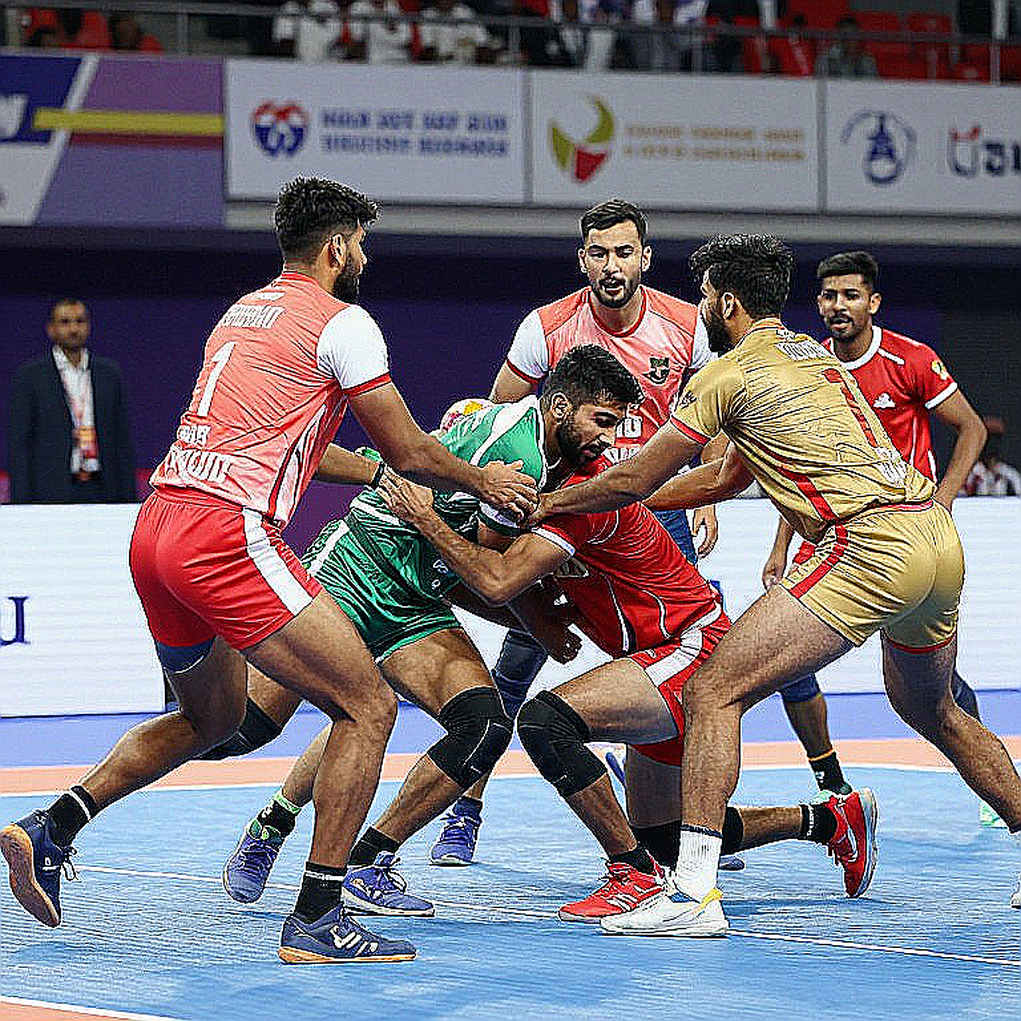
The expansion: two new teams, a familiar geography
The ten franchises are linked to Bhiwani, Rohtak, Karnal, Gurugram, Sonipat, Panipat, Faridabad, Hisar, Jhajjar and Kurukshetra. Every one of those cities is in Haryana. This is a regional league, and despite a name that evokes cricket or football's Champions League, its geographic footprint does not support any national claim.
That is not an automatic criticism. Haryana has one of India's densest kabaddi and wrestling traditions, where athletes raised in village akhadas have reached national and international level. A regional league spreading across that geography is logical. But it is also a fact that the league has no reported presence in Maharashtra, Punjab, Tamil Nadu, Telangana or Uttar Pradesh. Any 'national' or 'all-India' framing should be read with caution.
The Rs 5 crore purse: a large-looking number that is small in comparison
The most quoted figure in the report is the Rs 5 crore auction purse per franchise. First, it must be understood that this is not prize money but the squad-building budget within which bids can be placed. Second, at prevailing rates it is roughly US$600,000.
Set against PKL, whose franchises have historically spent several multiples more on squads, Rs 5 crore sits near the floor of PKL outlay — a developmental, semi-professional budget rather than the buying power of a national flagship team.
There is also a material ambiguity: the report does not clarify whether the Rs 5 crore is per franchise or league-wide. The phrasing ('greater scope to assemble their squads') suggests per franchise, but until that is explicit, conclusions built on the figure should be treated as provisional.
Auction numbers: Rs 17.4 lakh at the top, Rs 10 lakh for a 'captain'
Two names and two prices surface. The highest-priced player was Ayan Lochab at Rs 17.4 lakh. Sunil Malik, described as 'India's Asian Games captain', went for Rs 10 lakh.
Two things stand out. First, the gap between the top price and the credential claim runs the wrong way. A player who genuinely captains India at the Asian Games is typically worth more than Rs 10 lakh — roughly US$12,000 — particularly when the league's most expensive player cost Rs 17.4 lakh. There are only three possible explanations: the designation is dated or ceremonial, it refers to a different edition or a different rule variant, or the reporting is in error. None can be confirmed from this report.
Second, Ayan Lochab's position is unknown — raider, defender or all-rounder. There are no raid points, tackle points or success rates. Player quality cannot be assessed from gameplay data; only relative market prices are observable, and on a very thin sample.
Trials: 6,400 registrations, a pool of 300
The most concrete and most positive data point is that approximately 6,400 players registered for trials, and more than 300 entered the auction pool — a ratio of about one in twenty-one. That demonstrates the density of Haryana's kabaddi supply chain.
But this is where such stories usually trip. Six thousand four hundred registrations are not proof of the league's popularity. They are proof of a rural youth population for which sporting opportunity is scarce and thousands queue for every opening. This is a supply-side signal, not a demand-side one. Attendance, ticket sales, television ratings — none of it is reported.
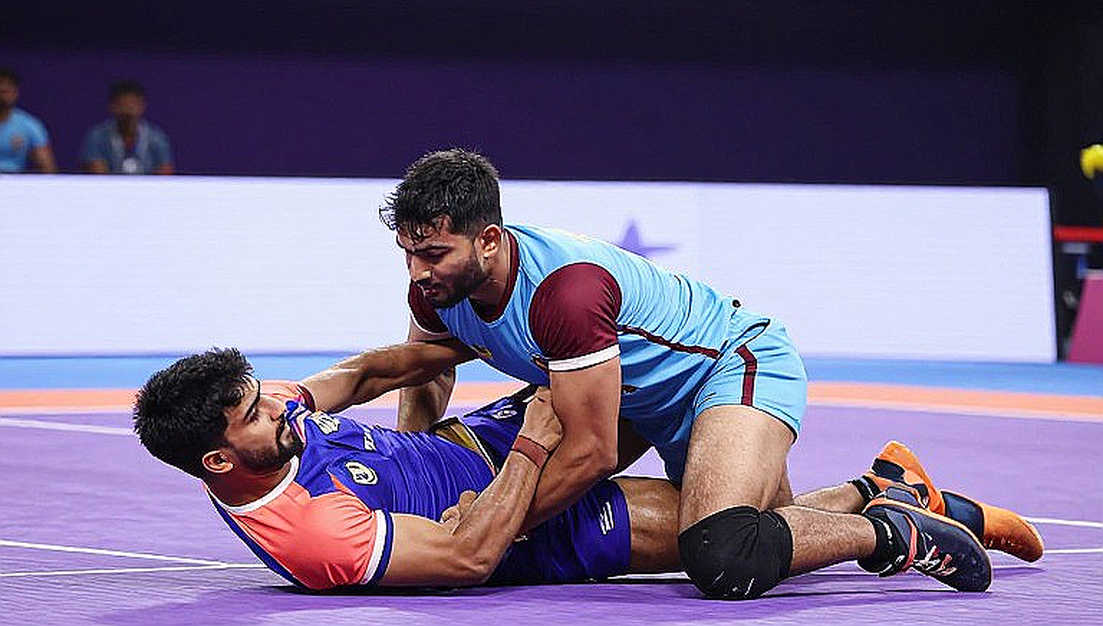
Understanding that distinction is the key to the whole story. A league whose trials draw thousands of players but which has no broadcast deal is giving opportunities to athletes; it is not selling a product to viewers.
Haryana's ecosystem: from akhada to contract
Haryana's sports economy matters here. Wrestling and kabaddi have grown for generations in village akhadas, and sports quotas in government jobs have financed the ecosystem. Becoming a contracted professional athlete remains the exception, not the rule.
The league's salary structure reflects this. The top bid is Rs 17.4 lakh, roughly US$21,000. PKL star raiders routinely command more than Rs 1 crore. The highest price here is about one-sixth of a single PKL star's valuation.
That is not necessarily bad news. It most likely means most players are semi-professional, combining sport with other employment or study, and this contract is supplementary income rather than primary income. But it also means the league is not, at present, positioned to pull PKL's top talent — even with PKL dormant.
The real context: PKL's broadcast crisis
This is the most important and least discussed part of the story. PKL's thirteenth season may reportedly slip to June-July 2027 because of a broadcast-rights problem. The implication is that the platform which turned kabaddi into a television product from 2026 onwards currently has no media partner, and no replacement has been named.
Kabaddi's entire modern commercial model depends on broadcast. A fast, sixty-minute, short-format sport is built for television. Ticket revenue is a small share of any Indian non-cricket league's income; the money comes from media rights and sponsorship. If that stream dries up, the crisis is structural, not merely calendrical.
So the Champions League's expansion should be read as an attempt to fill a vacuum. With PKL uncertain, a regional league gains access to idle talent. That is opportunism — not inherently bad, but misleading if presented as evidence of the league's strength.
A tier comparison
PKL is the national, professional tier, built on stars, television and major brands, and is currently in a broadcast crisis. The Kabaddi Champions League is regional and semi-professional, built on Haryana's local talent supply, with a wholly unverified commercial side. The third tier is the akhada and village sports culture from which the 6,400 registrations came.
That three-tier structure is healthy in principle — any sport needs competition below the top. The problem is that the middle tier, PKL, is currently weak. And when the middle tier weakens, the tier above suffers too, because the national-team pipeline runs through that professional league.
Commercial picture: what is said and what is absent
The report discusses team count and purse size, but provides not a single figure on broadcast deals, sponsorship, attendance, ticket revenue or total revenue.
This is not a minor omission. Expansion means higher costs — more teams, more matches, more staging expenses, more player payments. Claiming expansion with no revenue data is a serious analytical gap. India's non-cricket league history is unforgiving on this point: many leagues expanded on early enthusiasm and then shrank or folded when revenue failed to follow.
One plausible reading is that the Rs 5 crore purse is funded by franchise owners or a promoter rather than earned through league revenue, a common early-stage pattern in Indian leagues. That is inference, not fact.
A simple arithmetic check is also available. If Rs 5 crore must cover a squad of fifteen to twenty players, the average payment would be Rs 25-33 lakh — yet the top bid is only Rs 17.4 lakh. Either squads are very large or the budget is not fully spent. That too is speculation, since squad sizes are not disclosed.
Governance: the largest unanswered question
The report does not say who runs this league. Is it sanctioned by the Amateur Kabaddi Federation of India (AKFI) or the International Kabaddi Federation (IKF), or is it an independent private promoter's competition?
This is not a technicality. Sanctioning directly affects player eligibility. A player appearing in an unsanctioned league can face complications in national-team selection — especially significant for someone carrying an 'Asian Games captain' designation.
Similarly, nothing is disclosed on player contract terms, anti-doping arrangements, referee standardisation or which rule variant applies. Semi-professional and regional competitions commonly have weak provisions here, and this is precisely where athletes are most exposed.
On rules: the report does not clarify whether Standard Style (rectangular court) or Circle Style applies. PKL and international events use Standard; rural Punjab favours Circle. The difference changes the product itself.
The risk picture in three layers
First, ecosystem risk. PKL has no new media partner and its season is slipping to 2027. That is a systemic commercial shock, not a scheduling tweak. Because the professional layer is broadcast-dependent, a prolonged pause can damage both player development and the national-team pipeline.
Second, governance risk. Sanctioning, contract protection and anti-doping are unverified. A fast-expanding unsanctioned league can fragment the player market and complicate selection.
Third, transparency risk. Expansion and purse claims have no revenue or broadcast backing. Until hard numbers appear, they are promotional.
The heaviest of the three is the first — and, ironically, it is absent from the headline.
Player welfare: is this league changing lives?
The most attractive narrative is the 'village to contract' journey. Thousands of trialists prove that aspiration in Haryana is abundant. But aspiration and livelihood are different things.
Rs 17.4 lakh and Rs 10 lakh can matter greatly to a player with no other income, but it is one-season money, and if the league's future is uncertain, so is the income. Compare PKL, where top players are bought for crores and carry major endorsement deals. Here the most expensive player went for Rs 17.4 lakh — a real opportunity, but not a career transformation.
There is a positive side. If the league gives semi-professional players regular competition, it creates genuine developmental value even if the financial value is small. During a PKL pause that becomes more important, because otherwise hundreds of players face a year without competitive matches.
The name: ambition versus reality
'Kabaddi Champions League' reads like an attempt to borrow the prestige of football's UEFA brand. It signals commercial ambition, but it can also confuse readers about status. Ten franchises in one state is a clear mismatch with that name.
The suggestion is not to rename the league, but to keep its tier explicit in reporting: a regional development league, not a national competition. Readers, sponsors and players all need that clarity.
Five signals to track
One: PKL's new media-rights deal. If it arrives and Season 13 is confirmed for 2027, ecosystem uncertainty eases and the Champions League returns to its natural feeder role. If delay deepens, space widens for regional leagues.
Two: the Champions League's sanctioning. An official statement from AKFI or IKF would establish legitimacy as a feeder; silence leaves eligibility risk intact.
Three: a broadcast deal for the league. Any confirmed television or digital rights would validate the expansion claim.
Four: attendance and revenue data. The first honest test of commercial viability.
Five: verification of player credentials. Sunil Malik's 'Asian Games captain' designation should be checked against official rosters.
Conclusion
The story splits into two parts of unequal weight. The first is a Haryana-centric semi-professional league expanding from eight to ten teams, with a Rs 5 crore purse and 6,400 trialists — a small, local, limited-impact development whose strongest asset is its grassroots reach and whose weakest is its unverified commercial base.
The second is the broadcast crisis at Indian kabaddi's leading commercial platform, pushing its season to 2027 — a large, systemic, far-reaching event that will affect the sport's entire supply chain.
Read only the headline and the league appears to be advancing. Read the whole report and it becomes clear that it is advancing because the real stage is retreating. That is the most honest summary available.
One final caveat: this analysis rests on a single media report in which most claims carry no named source. The auction figures, the credential labels and PKL's calendar are all unverified. They should be read as claims to be checked, not as settled facts.